



Mandalay
Destinations
Mandalay
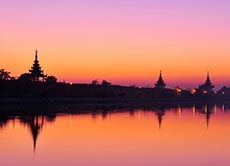
The Last Capital of the Myanmar Kings and the Centre of culture and of many traditional arts. Mandalay is known for ivory and wood caring, silk weaving, gold embroidery, silverware and stone carving and many other cottage industries.
Environs are Sagaing, one of the ancient capitals and now a retreat for devout Buddhists, Amarapura another old capital noted for its silk weaving industry, Inwa, also a historic capital known for the impressive Okkyaung monastery, Mingun, across the Ayeyarwady River from Mandalay is noted for its enormous Bell and the unfinished Pagoda, Pyin-U-Lwin (Maymyo) a pine-clad hill station over 1100 metres above the sea-level.
Besides the Mandalay hill, the palace wall, and the palace which is newly built, many other places in Mandalay attract tourists. Visiting the Great Maha Muni Pagoda is among them a top priority, which lies to the south of Mandalay.
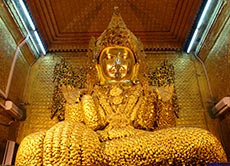
This pagoda was so named after the holy image.’Maha Muni’ housed therein. Originally, this holy image belonged to Myohaung ( a town in Rakhine State, the western coastal region of Myanmar;). In 1784, King Bodawpaya (a son of King Alaungpaya who founded the Kon-Baung dynasty;) got the image brought by his son to the then royal capital at Amarapura. lt has been 210 years, therefore, since the Holy Image first arrived at the central Myanmar. To the Buddhists in Myanmar, this richly gilded Maha Muni image is not a mere representation of the Lord Buddha but is an icon which is considered sacred itself. And the image is also regarded as the greatest in Myanmar next to the Shwe Dagon.
Another celebrated pagoda is the Kyauk Tawgyi situated near the southern approach to the Mandalay hill. lt was built in the reign of King Mindon. Also at this pagoda, there is a huge marble image of Buddha which was carved out of a single block of marble. Situated to the east is the Kuthodaw pagoda modelled on the Shwe Zigon at Nyaung Oo. In the precincts of this pagoda, there are 729 monolitlis on which the entire teachings of Buddha can be seen as edited and approved by the fifth Buddhist Synod. The Atumashi Kyaung (which literally means the inimitable monastery) also is worth seeing. Actually, it is just the ruins partly survived the fire in 1890. However, the remains seen nowadays obviously show that the Atumashi Kyaung must have been indeed an inimitable one in former times.
Moreover, such places as the Eindawya pagoda, the Set Kya Thiha pagoda, the Shwe Nandaw monastery, the old Watch Tower, King Mindon’s tomb,etc. should also be visited in Mandalay. In addition, the old royal capitals prior to the city of Mandalay (Amarapura, Inwa, Sagaing ) should also be visited during your stay in Mandalay. And you should not either leave Pyin Oo Lwin (May Myo) unvisited, for it may well be the most pleasant place in Myanmar and even in South East Asia, perhaps. It is situated 69 km to the east of Mandalay, over l, 100 metre sin elevation. In the colonial days, Pyin Oo Lwin used to be the summer resort of the Governor.
Pyin-Oo-Lwin
Pyin-Oo-Lwin is situated on the Shan Plateau About 42 miles to the north-east of Mandalay. As it is over 3,000 feet above sea-level it is cool the whole year round. Pyin-Oo-Lwin was known as Maymyo in the past. It was named after Colonel May of the 5th Bengal Regiment, who established it as a Hill station in 1886 to enable officers of the British Army based in Mandalay to go up to Maymyo on vacation. The town became famous as a hill station and summer resort in the time of the British colonialism and is still enjoying this popularity. It is in the Mandalay Division.
Pyin-Oo-Lwin can be reached by road or rail; it takes over two hours to travel by car from Mandalay. The road to Pyin-Oo-Lwin winds up the hills and there are many hairpin bends along the Way. As one reaches the View-Point at the 21-mile which is half-way to Pyin-Oo-Lwin, one can have a bird’s-eye view of Mandalay in the distance below. There are many food shops at 21-mile station and cars stop over there to change water in the radiator. Different kinds of food are available there, and a traveller can take his pick.
Climbing higher from the 21-mile station one can breathe fresh air from the hills. The climate gradually becomes cooler and cooler as one climbs up further. The scene everywhere is green and pleasant. As one approaches the Aungchantha village near the outskirts of the town, long lines of stalls selling vegetables and fruits can be seen on either side of the road. There, flowers of different kinds and colours, fresh and green vegetables and fruits can be bought to your liking. Soil rich Pyin-Oo-Lwin and its vicinity abound with flowers, vegetables and fruits. Coffee, damson, strawberry, plum and pineapple are grown at orchards and plantations on commercial basis. Trees such as Pines, Cherry, In, Kanyin, Padauk, Htauksha and Thingan also grow well there. Different kinds of flowers and many varieties of orchids grow in profusion in Pyin-Oo-Lwin. As such, it is also known as “Pan-myo-daw” in Myanmar, meaning the town of flowers.
Being a hill station of the British colonial government once. Pyin-Oo-Lwin still has some offices, houses, bungalows, churches and recreation centres – relics of the past. These buildings have a central fire place to give warmth during the cold season, and chimneys to let out the smoke. The Candacraing Hotel and Nanmyaing Hotel are of ancient British architectural designs, and foreigners take keen interest in them. Another interesting place to visit in Pyin-Oo-Lwin is the Central Market; the clock tower near the market is also one of the most significant landmarks of Pyin-Oo-Lwin. In the market are sold fresh vegetables, fruits, flowers, and other regional products. The market is always crowded with buyers and sellers; different national races who live in the hilly regions frequent the market.
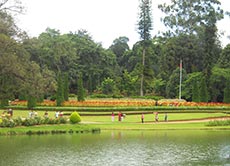
Another place of interest is the Botanical Gardens, which occupy a land of 432 acres. There are different kinds of flowers, shrubs and plants. There are also beautiful lawns, huge trees providing shade, and different kinds of medicinal plants. Gravel paths are also built inside the garden.
Sagaing
Sagaing Hill
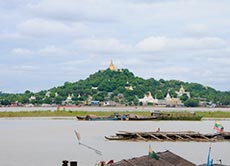
Inwa Bridge
The road to Sagaing crosses the river on the sixteen span Inwa Bridge which is well over one km long. Opened in 1934 the bridge was put out of action by the British in 1942 when they demolished two spans in order to deny the bridge to the advancing Japanese. Not until 1954 was the bridge repaired and put back into operation. There’s a toll to take cars across the bridge which also carries the rail line. Inwa Bridge used to be the longest bridge in Myanmar until the emergence of Thanlyin Bridge in 1993.
Thabyedan Fort
Just to the left of the bridge, on the Mandalay and Inwa side, is the fort of Thabyedan which was built as a last ditch defence by the Myanmar before the third Anglo-Myanmar war.
Kaunghmudaw Pagoda
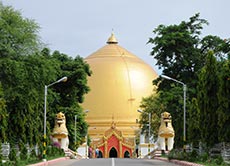
Tupayon Pagoda
Tupayon Pagoda Constructed by King Narapati of Inwa in 1444, the Tupayon is of an unusual style for Myanmar consisting of three circular storeys each encircled with arched niches.
Ngadatkyi Pagoda
This was built in 1657 and houses a fine and very large seated Buddha image.
Hsinmyashin Pagoda
is known as the Pagoda of Many Elephants. It is built in 1429 . Badly damaged in an earthquake in 1485, it was subsequently repaired but suffered even worse damage in a quake in 1955.
Amarapura
Situated about 11 km south of Mandalay, Amarapura is an ancient capital of the Konbaung Dynasty. The modern town of Amarapura is often referred to as Taungmyo “the southern city” to distinguish it from Mandalay, the northern city. The old name means “city of immort`a1ity”but Amarapura`s period as a capital was brief. Amarapura was founded as his new capital by Bodawpaya in 1783, soon after he ascended to the throne. In 1823 Bagyidaw moved back to Inwa. In 1841 Amarapura again .became the capital but in 1857 Mindon decided to make Mandalay the capital and the changeover was completed in 1860. There are several places of interest in this ancient city which was also the site for the first British embassy in Myanmar in 1795. Amarapura is noted for silk and cotton weaving and bronze casting.
Patodawgyi Pagoda
Built by Bagyidaw in 1820 this well preserved pagoda stood outside the old city walls. The lower terraces have marble slabs illustrating scenes from the Jataka. You’ll have a fine View over the surrounding countryside from the upper terrace. An inscription stone, within the temple precincts, details the history of the pagoda’s construction.
Palace Ruins
Little remains of the old Amarapura palace but you can still find two masonry buildings the treasury building and the old watch tower. King Bagidaw and King Bodawpaya were both buried here and their tombs also remain. The corner pagodas still stand at the four corners of the once square city.
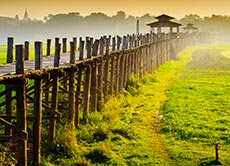
U Bein’s Bridge
Kyauktawgyi Pagoda
This was constructed in 1847 by King Bagan and it was modeled on the larger Ananda Temple at Bagan area.
Mingun
Mingun Pagoda
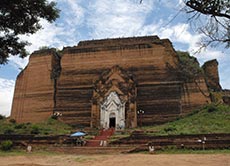
If King Bodawpaya had succeeded in his grandiose scheme, Mingun might now have the world‘s largest pagoda. When Bodawpaya died in 1819, the construction was abandoned. Each side of the enormous base measures 72 metres (235 feet) and the lowest terrace measures 140 metres [450 feet). There are projecting arches on each of the four sides.
Pondawpaya
Closer to the riverbank a little downstream from the Mingun Pagoda is this five metre (15 feet) high working model for the gigantic structure. It gives a clear picture of just what Bodawpaya intended to achieve.
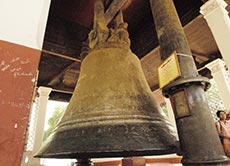
Mingun Bell
Hsinbyume or Myatheindan Pagoda
Built by King Bagyidaw in 1816, three years before he succeeded Bodawpaya as king, the pagoda was constructed in memory of his senior wife the Hsinbyume princess. It is built as a representation of the Sulamani Pagoda which, according to the Buddhist plan of the cosmos, stands atop Mount Meru. The seven wavy terraces around the pagoda represent the seven mountain ranges around Mount Meru. This pagoda was badly damaged in 1838 by a quake but King Mindon restored it in 1874.
Settawya Pagoda
Close to the riverbank downstream from the Pondawpaya model, the hollow, vaulted shrine has a footprint of the Buddha which was brought to Mingun by King Bodawpaya when the relic chamber in the base of his huge pagoda was sealed up. The temple was built in 1811.
Mon Ywa
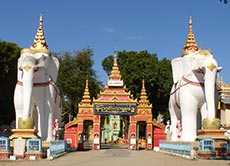
Mon Ywa is a town located just three hours’ drive to the east of Mandalay. In former times, it was also known as.the City of Thalawaddy. Mon Ywa has an array of sightseeing spots for overseas visitors, ranging from historical and religious edifices to the famous lacquerwork industry. It can be reached by road, rail, water, and air. So conveniently situated, Mon Ywa should also be listed in the itineraries of tourists, in addition to the high-lights of Upper Myanmar such as Mandalay, Bagan/ Nyaung Oo, Sagaing, Mingon, and so on. Among the places of interest in Mon Ywa, noteworthy is Bodi Tahtaung which means One Thousand Bo Trees. There, you can see – or if you happen to be a Buddhist, can pay obeisance to – a thousand images of Buddha and a thousand Bo trees.
Bodi Tahtaung Reclining Buddha Image
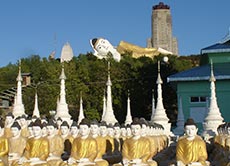
To the east of Bodi Tathtaung is the Po Khaung mountain ranges where lies a colossal reclining Buddha image. It is the largest among the reclining Buddha images ever built in Myanmar. According to the records, this great image was first built in 1991 and it measures 300 ft in length and 37.5 ft in width. The head of the image alone measures 60 ft in height. The couch on which the image lies measures 322.5 ft in length and 60 ft in width.
Aung Sakkya Pagoda
This pagoda also stands on the Po Khaung mountain ranges, near the great reclining Buddha image. This pagoda measures 225 ft in height in addition to its base which is 216.75 ft high. Therefore, the total height of the pagoda is 441.75 ft. Certainly, Aung Sakkya is the landmark of Mon Ywa and its environs as it can be seen from all angles from afar. The pagoda is circled by 1,060 satellite pagodas and in possession of more than a thousand sanctified Buddha images.
Moe Nyin Thanbuddhai Pagoda
Alaung-daw Kassapa
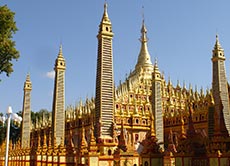
Situated 60 miles to the northwest of Mon Ywa is this renowned place of interest called Alaung daw- Kassapa. A journey to this involves some 17 miles _of a tough trekking and elephant ride besides the trips by road and water. It is recommended especially for those keen on adventurous walks in a jungle. Kassapa is in fact the name of an Arhat whose remains, it is believed, are kept in this place. However, what you can see there is but the representation of the reclining Arhctt. Other places of interest include .Po Wun Mountain and Shwe Ba Mountain where magnificent stone carvings ancl engravings dating back presumably to 1 l th century – can be observed. There, you can also enjoy yourselves feeding the monkeys along your trip uphill. These mountains are some 1,000 ft in height and located on the bank of the Chin-dwin river, opposite Mon Ywa.