



Yangon
Destinations
Yangon
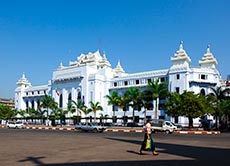
The capital and gateway city to Myanmar, Yangon is evergreen and cool with lush tropical trees, Shady Parks and beautiful Lakes Without sky-scrapers, noisy traffic, crowded squalor and the hectic pace of modern life, Yangon is attractive in its own social way. The oldest Buddhist Shrine Shwedagon Pagoda dating back over 2500 years is the main attraction of Yangon.
Environs are Bago (Pegu) the ancient capital of Mon Kingdom 80 km north of Yangon,Tanyin (Syriam) a former, settlement of Portuguese seamen across the river from Yangon,Tuntay,a small river town about 2 hours by boat from Yangon
Shwedagon Pagoda
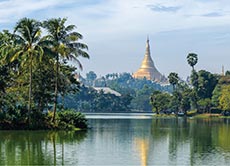
Shwedagon Pagoda Towering almost 100 metres above the green city-scape of Yangon, the ShweDagon Pagoda is the prominent landmark visible from miles around. One of the wonders of the world, the Shwe Dagon is believed to have been built approximately 2,500 years ago. It is the essence of Myanmar and a place that never fails to enchant. The great golden dome rises 98 metres (326 feet) above its base. The legend of the Shwedagon tells of two merchant brothers meeting the Buddha who gave them eight strands of his hair to be enshrined in Shwe Dagon. With he help of a number of celestial beings, the brothers and the king of this region (Myanmar) discovered the hill where the relics of the previous Buddhas had ‘been enshrined. When the strands of the Buddha’s hair were safely enshrined together with the relics of the preceeding Buddhas, agoldenslab was laid on the relics chamber and a golden pagoda built on it. Over this a silver pagoda was built, then a tin pagoda, a copper pagoda, a lead pagoda, a marble pagoda and finally an iron brick pagoda. Pagodas, indeed all Buddhist structures, should properly be walked around clockwise.
Sule Pagoda
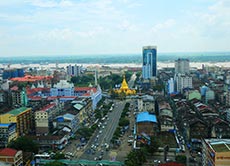
Botahtaung Pagoda
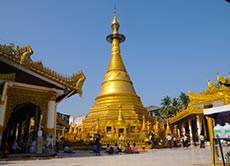
Botahtaung Pagoda Bo means “leader” and tahtaung means “a thousand“ – the Botataung Pagoda was named after the thousand military leaders who escorted relics of the Buddha brought from India over two thousand years ago. The Botataung is hollow inside and you can walk through it. lt’s a sort of mirrored maze inside the pagoda with glass show-cases containing many of the ancient relics and artifacts which were sealed inside the earlier pagoda. Above this interesting interior, the golden pagoda spire rises to 40 metres (132 feet).
Kaba Aye Pagoda
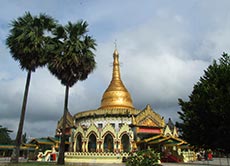
The name Kaba Aye in Myanmar means” world peace” to which this pagoda is dedicated. This pagoda was built in 1952 for the 1954-56 Sixth Buddhist Synod. The 34 metre (1 l 1) high pagoda also measures 34 metres around its base. It stands about 11 km north of the city, a little beyond the Inya Lake Hotel. The Buddhist Art Museum and Maha Pasana Cave are also located in the same compound.
Maha Pasana Guha
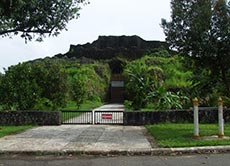
The “great cave” is an artificial “cave” built close to the Kaba Aye Pagoda. It was here that the Sixth Buddhist Synod was held to coincide with the 2500*th anniversary of the Buddha‘s enlightenment. The participants recited, edited, and approved the entire Buddhist scriptures known as the Tipitaka. The cavern measures 139 by 1 13 metres (455 by 370 feet).
Chauk Htat Gyi Pagoda
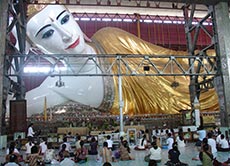
The reclining Buddha image there is one of the largest images in Myanmar. The original image was built in 1907. But it has suffered damage due to climate over the years. In 1957 it was demolished and rebuilt to this structure in 1966. The pagoda is on Shwegondine Rd, only a short distance beyond the Shwedagon Pagoda. lf you can’t get to Bago to see the Shwethalyaung, then don‘t miss this colossal im-age.
Mai-Lamu Pagoda
A wonderland of spired pagodas and sculptured figures located in North Okkalapa, a satellite town about 20 minutes’ drive from the city centre. Mai-Lamu Pagoda is famous for the giant images depicting Buddha’s earlier lives.
Mahavijaya Pagoda
The symbolic memorial of the First Successful Congregation of the Sanghas of All Orders held in 1980, this elegant Mahavijaya Pagoda is a unique blend of traditional patterns and the modern styles. The sanctuary contains the finely wrought Buddha images and the reliquary donated by the King and Queen of Nepal.
National Museum
Zoological Garden
Zoological Garden Located near Kandawgyi Hotel, the Zoo is noted for its collection of wild animals, flora and fauna which have been collected over the years since it was opened in 1906. On weekend and public holidays Snake Dance and Elephant Circus are performed for visitors.
Admission fees for foreign visitors are special as follows:
| Resident Foreigners | FEC$ 2.00 |
| Tourists | FEC$ 5.00 |
Myanma Agriculture Service Vegetables & Fruits Research & Development Centre
This garden offers plenty of fruits and vegetables of Myanmar agricultural sector which has a rich farmland and abundant fruit orchids. It is located on the Yangon-Mandalay Road. It takes a little more than an hour’s drive before reaching Bago. The entrance fee is US$ 2. In the garden, visitors may experience a bullock ride.
Penple’s Square and People’s Park This Park
This park occupies over 130 acres of land between Shwedagon Pagoda and Pyithu Hluttaw (Parliament). There is a Museum housing life-size models of nationalities in their colourful dress and flora and fauna. The Restaurant serves Myanmar, Chinese and European Food.
Open from 7 a.m. to 7 p.m.
| Entrance Fee | USS; 3 |
| Camera Fee | US$ 3 |
| Video Camera Fee | US$ 6 |
Bogyoke Aung San Park
A scenic park with a lovely view of Kandawgyi Lake is located on Natmauk Road. The Park is a popular recreation centre Where city-dwellers relax and spend their leisure in peace and quiet. The playgrounds and picnic areas are favorite spots for children and teenagers.
Hlawga Wildlife Park
This Park is about 45 minutes’ drive from the city. The Park which covers 1,650 acres of land and the Lake is home to over. 70 kinds of herbivorous animals and 90 species of birds. Flocks of migratory birds frequently visit the park. It is an ideal place for picnickers, naturalists, botanists and bird- watchers. Visitors can also enjoy elephant rides, boating and fishing in the park.
Allied War Memorial Cemetery
Martyrs’ Mausoleum
Martyrs’ Mausoleum Close to the Shwe Dagon and on a hill offering a good view over the city stands this memorial to General Aung San, Myanmar’s national hero, and his fellow cabinet members who -were assassinated with him on 19″‘ July, 1947.
Thanlyin (Syriam) and Kyauktan
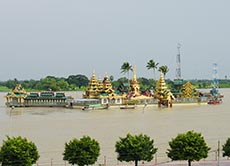
It is an interesting excursion across the river to Thanlyin and on to an interesting pagoda at Kyauktan. In Thanlyin, a bus ride out of town will take you to the large, golden Kyaik-khauk Pagoda rising on a hillock to the right of the road. Just before this pagoda are the tombs of two famous Myanmar Poets Laureate – Natshinaung and Padethayaza. There are many places of interest in Thanlyin worth visiting; the ruins of an old Portuguese Church built during the 18″‘ century, the Sacred Heart Church built in 1870 by French Missionary, and so on.
There is Ye Lé Paya which literally means “the pagoda at the centre of the river” at Kyauktan. It’s appropriately named since the complex is perched on a tiny island in the middle of the river. In the temple there are pictures of other famous pagodas all over Myanmar and even further afield. The longest bridge in Myanmar lies between Yangon and Thanlyin. It takes only an hour-drive to reach Thanlyin.
Twante’
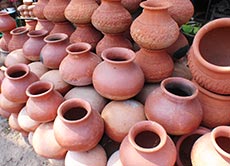
A boat cruise to Twante (24 km from Yangon) along the Twante Canal takes about two hours. Twante is noted for its pottery and cotton-weaving industries and a riverine trip to Twante also affords visitors an opportunity to see life along the canal.
BOGYOKE AUNG SAN MARKET
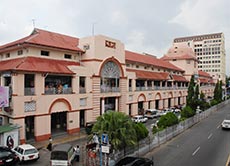
NEW BO GYOKE MARKET
This market is situated opposite the Bogyoke market, where imported textiles, household appliances, medicines, etc.. are largely availaxble.MINGALAR MARKET This is the biggest whole-sale market in Yangon where a variety of goods are distributed countrywide.
Bago
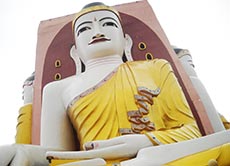
Shwe Mawdaw Pagoda
Shwe Thalyaung Image (Reclining Image)
Maha Zedi
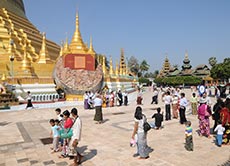
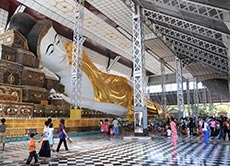
This pagoda dates back to the mid l6th century. Maha Zedi may well be the most famous among the pagodas built by His Majesty King Bayinnaung, who is regarded as the most powerful king in Myanmar history. Other places of interest include Kyaik-pon Pagoda, Kalyani Sima (Ordination Hall), excavation site of the ancient capital Hansavaddy, and Bago market. What you shouldn‘t miss either is the city’s famous cheroot-making industry. You can also experience a ride in Thone-bein car – literally, three-wheeler – in Bago, which is equivalent to Tok Tok in Bangkok. Uncomfortable will be your ride. But it is fun indeed to go round the town on such a noisy, vibrating, and slow- going three-Wheeler of postwar Vintage. Thone-bein has the seating capacity – without luggage – of five. Still, it is very common in the town to see a Thone-bein crowded with at least ten passengers. This kind of taxi is not available in the capital Yangon.
Pyay (Sri Ksetra)
The site of Sri Ksetra Palace is located practically at the centre of the ancient city, near a village called Taung-lon-nyo these days. Originally, the palace was 1,700 ft in length and 1,125 ft in width. Now, the bottom of the palace is still a part of the ruins, composed of wide bricks as were then used. The upper parts were restored with the new bricks of our time. Besides the city wall and the site of the palace, there are many other archaeological structures in Sri Ksetra and its environs. Noteworthy among others are as follows:
Vishnu City
This ancient city is located to the south of and outside the city wall ol`S1’iKsetrct, Only the site of the city remains and is square in shape. lt is said that King Duttabong had the Vishnu city built specially and separately for his beloved Queen Vishnu.
Tomb of Queen Vishnu
The tomb is located at the northeast corner of the Vishnu City and obviously square in shape. Found inside the tomb – at the level lower than the surface — are 6 huge containers made of stone.
Myin-va-hu Sima
This ancient si/na (ordination hall) is located on the hill where the Myin-va-hu stupa was built. lt is traditionally believed that Myin-va-hu is one of the nine simas patronized by King Duttabong as well as the earliest simas in Myanmar history. The props of the buildings are unlike those of the present-day buildings, that are made of translucent alabaster and finely chiseled as well _ just roughly hewed stone pillars.
Stupas
Worth visiting among others are Baw-baw-gyi Stupa, Payama Stupa. and Payagyi Stupa. These ancient stupas are found to lack in detailed decorations such as Kyct Mhauk (part of a pagoda resembling an inverted lotus flower), Kya Lan (part of a pagoda resembling a spreading lotus flower), Khctung Laung (bell- like part of a pagoda), Paung Yit (ovolo moulding above Khaung Laung), Ywé Lon (ring of spherical bosses on a pagoda), and so on which are very common in the pagodas built of the later periods. Most of these stupas were built presumably in the early period of this Pyu era.
Temples
A lot of Pyu temples can still be found around Sri Ksetra. They are quite similar in architecture to those of the ancient city of Bagan. This indicates that Myanmar architects in olden days inherited the art from the Pgus. Highlights among the temples in Sri Ksetra are Eastern Zag Temple, Western Zay Temple, Bé-bé Temple, Lay-rnyebnhar Temple, Yahanta Temple, Paya Taung T emplc, to name a few.
Extracted from ” Archaeological finds from the Ancient City of Sri Ksetrcz.” by U Myo Myint, Deputy Chief, Information & Public Relations Department. Pyay District.