



Inle Lake
Destinations
Inle Lake
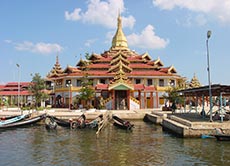
Sheltered amongst blue mountains over 1500 metres high, Inle Lake is Vast, beautiful and picturesque Known for its unique Leg-rowers, floating farms and Villages and Colourful Markets.
Environs are Taunggyi, a Popular hill resort over 1400 metres above the sea-Level, Kalaw a Peaceful summer resort with fragrant pines and lovely walks, Pindaya Caves, famous mountain caves where thousands of Buddha images are stored.
Pindaya
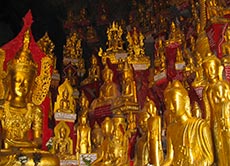
In the caves arc Buddha images of various sizes some carved on the face of the rock and others placed in niches in the walls of the cave. At the mouth of the cave is a Zedi which is about 50 feet high. Further inside the cave are more images of Buddha and stalactites and stalagmites are formed on the rocks. Water can be seen seeping out from the walls of the cave and pools of water are formed on the floor and are known as Natyaykan. There is also an underground tunnel inside the cave and is supposed to reach Bagan. As electric lights are brightly lit inside the cave, people can enter the cave and study. The cave can be reached by car as a road has been built leading to the cave. All those who tour southern Shan State should not fail to visit Pindaya.
Pindaya can be reached by road either from Taunggyi or Kalaw and it is 45 kilometers from Kalaw and 106 kilometres from Taunggyi. On the way to Kalaw one will find hillocks here and there and covered with pine forests which are really beautiful to see. There are also many plantations in the area and one can study the villages of Pa-O, Danu, Taungyo and Taungthu national races and their Taungya cultivation. On market days. the products of the region and crops cultivated by the national race sold and one can find many different national races gathered at the market buying and selling the products of the region. There are State-owned as well as private rest houses in Pindaya. where tourists and pilgrims who visit the area can get eommodations. People can hire taxis from Taunggyi and Kalaw if they Wish to visit Pindaya.
How Pindaya got its name can be found in history. It is said that Prince Komnabaya once came on a hunting expedition to west Nagapat Hill. He saw in the sky a galon – a giant mythical bird which is an arch-enemy of dragon – carrying away a dragon between its beaks, and the prince shot it down with his bow and arrows. When the gallon died, he was transformed into a gigantic spider. This spider is said to have trapped in the cave the seven daughters of the king of the Nats, known as Ngwetaung, who had come down to bathe in a pond at the foot of the mountain. The prince, when he saw this, killed the huge spider, too. When the spider died, shouted “Ya-by? (Got it) three times. It sounded ” pingu-yd’ meaning the spider was caught and the town came to be known by that name and gradually it was changed into Pindaya.
Padaung
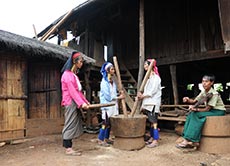
Padaung women wear the bronze rings not only around the neck but around the leg. In so doing, they wear the rings from the ankle to as high as the kneecap,. From bottom to top, the rings get bigger and bigger. It is beautiful in their own light and tradition. However, the custom of wearing such bronze rings gets less common. Only old Padaung women and some ladies who do not wish to give up the old tradition continue to wear the bronze rings. The present day youths no longer wear them. ln Kayah State, Padaung Women wearing bronze rings can only be found in the villages. They are generally old Women or ladies in their senior years: The youths may not be found wearing such rings.
Padaung is one of the Kayin national races. They are mostly found in Kayah State which was previously called Kayin State. Padaung nationals reside in a wide area. They live in Kayah State, southern Shan State and Kyin State as well as in the plains. like Toungoo and Pyinmana. They are well known for their hospitality. They are fit and healthy. They work hard and are actively engaged in farming. They call themselves Lay Kaung Doo.